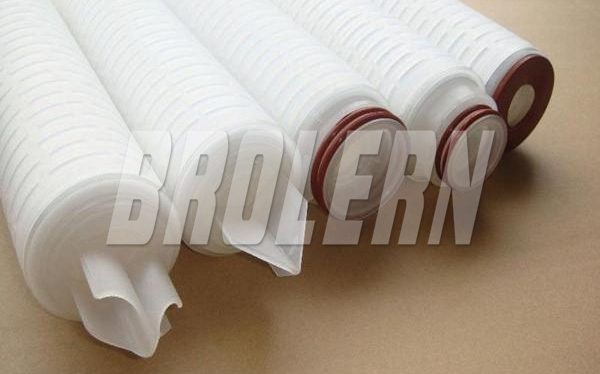
A pleated filter cartridge folds a large sheet of filter media into a small housing. That pleating is the whole point: it packs far more surface area into the same 10″ / 20″ envelope than a depth or wound cartridge, which translates directly into higher flow at a given pressure drop and the ability to hold a fine, often absolute, rating. Pleated membranes in particular are the standard for final polishing and sterile-grade duty. This article covers how pleats earn their keep, when to specify them, and where they fall short.
Why surface area matters
Filtration is a surface game for a pleated element — particles are caught on (or just below) the face of the media. More area means more places for particles to land, so for a fixed flow the face velocity is lower, the pressure drop is lower, and the element runs longer before it blinds. Where housing space is constrained but flow is high, pleating is often the only way to meet the spec.
Construction and media options
- Microglass or synthetic pleated media — economical, high area, good for general liquid and air polishing.
- Membrane pleated media (PES, nylon, PTFE) — sub-micron and absolute ratings, used where sterile or near-sterile retention is required.
- Thermally welded, adhesive-free construction — no glue to leach or fail; preferred in food, pharma and high-purity duty.
- Hard supportive cores — keep the pleats from collapsing under differential pressure.
Pleated vs depth: the core trade
| Factor | Pleated (surface) | Depth (melt-blown / wound / sintered) |
|---|---|---|
| Capture mechanism | Surface / shallow | Through the depth |
| Surface area | Very high | Lower per envelope |
| Best particle type | Uniform, hard particulates | Broad PSD, gels, deformables |
| Absolute / sterile rating | Yes (membrane) | Varies (sintered yes) |
| Gel / deformable loading | Blinds fast | Absorbs better |
| Cleanable? | Usually disposable | Sintered yes; others no |
The practical rule: use pleated for the final, fine, relatively clean stage; use depth media upstream to remove the bulk load so the pleats do not blind on coarse debris.
When to choose pleated
- High-flow polishing where you need fine retention without a huge housing.
- Sterile / sub-micron duty — membrane pleated cartridges for final filtration of liquids or process air.
- Low-pressure-drop requirements — when pump energy or cycle time is constrained.
- Adhesive-free, leachables-sensitive lines — thermally welded construction.
Cleanability and limits
Most pleated cartridges are disposable, because the fine media and supporting layers do not survive aggressive cleaning without losing rating or structure. Sintered stainless pleated-style elements are the exception — being rigid metal they can be cleaned and reused. If your process demands a cleanable fine element, that is the route to specify rather than a polymer pleat.
Specifying a pleated cartridge
- State an absolute rating (with a beta value) for engineered systems — not just nominal.
- Match the length and end-cap style to the housing (mismatches cause bypass).
- For sterile duty, confirm the membrane type, integrity-test method (bubble-point / diffusive flow) and compatibility with your sterilant.
- Confirm chemical compatibility of the media and seals with your fluid.
FAQ
Why are pleated cartridges more expensive per unit?
They are not always — but the value is area: for the same housing they deliver higher flow and finer retention than depth media, so you often need fewer or smaller housings. Compare on cost per filtered volume, not sticker price.
Can pleated filters be cleaned and reused?
Polymer pleats generally cannot be reliably cleaned without losing rating, so they are disposable. For a cleanable fine element, specify sintered stainless in a pleated-style form instead.
Do pleated cartridges blind faster than melt-blown?
On gel-like or very broad contaminant loads, yes — the surface clogs while depth media absorbs the load. Keep a depth pre-stage ahead of the pleat to protect it.
Conclusion
Pleated cartridges win on surface area: higher flow, lower pressure drop and fine-to-sterile retention in a compact envelope. They are the right final-stage choice for clean, uniform streams, especially where adhesive-free construction matters. Protect them with a depth pre-stage, and for a reusable fine element turn to sintered stainless. Our pleated range and engineers can match the media, rating and end-cap to your housing.