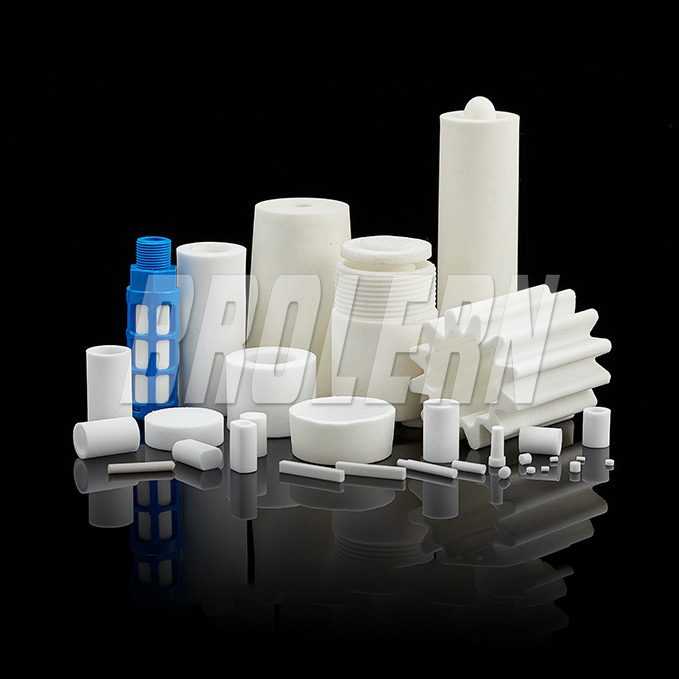
Fiber filter cartridges built from polypropylene (PP) and glass fiber are the workhorses of general industrial filtration — the economical element you reach for to pull sediment, rust and suspended solids out of water, chemicals and process streams. BROLERN's fiber media family covers PP and glass-fiber cartridges, RoHS compliant, with ratings down to 0.5µm. This article explains what each media is good at, how they differ from melt-blown and wound elements, and where they belong in a filtration train.
Two fibers, two jobs
| Media | Structure | Best for | Watch out for |
|---|---|---|---|
| Polypropylene (spun-bonded) | Bonded PP fiber, graded or uniform | General water, chemicals PP resists, cost-driven duty | Lower temperature ceiling; nominal ratings |
| Glass micro-fiber | Fine borosilicate fibers | Finer retention, higher flow per area | Confirm binder / shedding for product-contact duty |
Polypropylene is the default: it resists most acids, alkalis and many solvents, is inexpensive and handles the bulk-sediment role well. Glass fiber holds finer ratings at high flow and is common where a tighter cut or higher throughput is needed, provided the element's binder and construction suit the fluid.
Fiber vs melt-blown vs wound
These three are often confused because they overlap in price and duty. The distinction is the structure:
- Fiber (spun-bonded PP / glass) — a bonded fiber matrix; economical general-purpose depth or surface filtration, ratings down to 0.5µm.
- Melt-blown — thermally bonded nonwoven PP with a deliberately graded density; optimised for high dirt-holding on messy feeds (see melt-blown cartridges).
- Wound (string-wound) — yarn wound on a core; the cheapest bulk-sediment option, with a yarn-shift bypass risk to manage (see wound cartridges).
Rule of thumb: fiber for balanced general duty, melt-blown when the feed is dirty and you want long runs, wound only for the cheapest, least critical sediment role.
How they are specified
| Parameter | Typical range / note |
|---|---|
| Micron rating | Down to 0.5µm (usually nominal; verify if absolute is needed) |
| Length | 10″, 20″, 30″, 40″ — match the housing |
| Media | 100% PP or glass fiber, RoHS compliant |
| Temperature | PP typically to ~50–80°C; confirm per grade |
| Role | Pre-filtration / general industrial depth-surface duty |
PP and glass-fiber cartridges are normally quoted on a nominal rating. Where a downstream component is critical, follow a fiber stage with a verified absolute element (pleated or sintered) rather than trusting the nominal label alone.
Where PP and glass-fiber cartridges are used
- RO and membrane pre-filtration — protecting membranes and carbon beds from sediment.
- Process and potable water — rust, sand and suspended-solids removal ahead of finer stages.
- Chemicals and plating — where PP resists the fluid (confirm against your chemistry).
- General industrial and OEM — the economical default cartridge for equipment builders.
FAQ
Are these cartridges cleanable and reusable?
Generally no. PP and glass-fiber elements are treated as disposable consumables; once loaded, they are replaced. If you need to clean and reuse, move to a sintered metal element.
What is the difference between nominal and absolute rating?
A nominal rating is a broad efficiency class, not a guaranteed cut. An absolute rating is a verified minimum particle size the element is tested to retain. For critical stages, ask which one the number refers to and how it is verified.
Can I use a PP cartridge for solvents?
Only for the solvents PP actually resists. For aggressive or strong solvents, a fluoropolymer element such as PVF or a compatible metal element is the safer choice — send us the fluid for a compatibility check.
Conclusion
Polypropylene and glass-fiber cartridges are the economical backbone of general industrial filtration: broad chemical compatibility, ratings to 0.5µm and RoHS compliance, at a price that suits high-volume pre-filtration. Match the media to the fluid — PP for general aqueous and compatible-chemical duty, glass fiber for finer cuts and higher flow — and follow with an absolute stage where the downstream equipment demands it. Tell us your fluid, rating, length and housing, and the BROLERN team will confirm the right fiber media and send a sample.