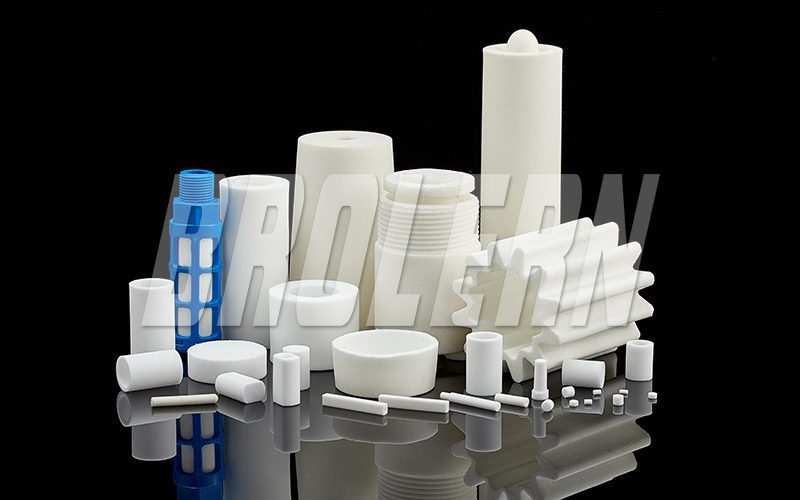
A PVF filter cartridge is a sintered element made from a chemically resistant fluoropolymer. Instead of the round, packed pores of a powder element, PVF forms a continuous dendritic network — a web of interconnected channels that stays open under load. That structure is why the PVF media family is specified for three things at once: very high porosity (above 90%), high flow at low pressure drop, and zero fibre shedding into the fluid. This article explains what that structure buys you and where PVF earns its place over plastic, metal or fibrous media.
What the dendritic structure does
Porosity above 90% means the element is mostly open space — far more open than a powder-sintered or woven element at a comparable rating. Because the channels are continuous and connected rather than a tangle of isolated pockets, fluid finds an easy path straight through. The practical consequences:
- High flow at low ΔP. Less restriction for the same rating, so smaller housings or longer runs between change-outs.
- High dirt-holding for its size. The open volume stores contaminant instead of blinding at a surface.
- No media migration. There are no fibres or loose wires to shed downstream — critical where a stray particle would contaminate a product or damage a fine component.
PVF vs the media it replaces
| Property | PVF (fluoropolymer) | Sintered PE/PP plastic | Fibrous / melt-blown |
|---|---|---|---|
| Porosity | Very high (>90%) | Moderate | High but fibre-based |
| Flow at low ΔP | Excellent | Good | Good |
| Chemical resistance | Very broad (fluoropolymer) | Broad vs aqueous | Limited by resin |
| Fibre shedding | None | None | Possible |
| Typical role | Aggressive / high-flow / no-shed duty | Food, general aqueous | Bulk sediment, cost-driven |
Reach for PVF when two requirements collide: the fluid is aggressive (solvents, strong acids or bases, oxidizers) and the process cannot tolerate fibre shedding or a high pressure drop. If the duty is mild aqueous service, sintered plastic is usually the economical answer; if it is hot or high-pressure, sintered metal wins.
Where PVF cartridges are specified
- Chemicals, coatings and inks — aggressive solvents and pigment streams where plastic media would be attacked and fibre shedding would create defects.
- Electronics and semiconductor — high-purity etch, clean and process chemicals that must stay particle-free.
- High-flow gas and liquid — breathers, spargers and transfer lines where a low ΔP keeps the process moving.
- Analytical and instrumentation — protecting sensors and valves from debris without adding restriction.
Specifying tips
- Confirm the exact fluid and concentration — “fluoropolymer” spans a family of grades, and compatibility is grade-specific. Send the fluid and temperature for a compatibility check.
- State the target rating and whether it must be absolute (verified) or nominal.
- For a bespoke geometry, PVF elements can be produced to drawing or sample like the rest of the sintered and custom solutions range.
FAQ
Is PVF the same as PTFE?
They are both fluoropolymers with broad chemical resistance, but they are different materials with different processing and temperature behaviour. Treat PVF as its own media and confirm the grade against your specific fluid rather than assuming PTFE data applies.
Why does high porosity matter to me?
Higher porosity means more open volume, so more flow at a lower pressure drop and more dirt stored before the element blinds. In practice that is smaller housings, lower pumping cost and longer service intervals.
Will a PVF element shed fibres into my product?
No. PVF is a continuous bonded structure with no loose fibres or wires, which is exactly why it is chosen for electronics, coatings and high-purity duty where media migration is unacceptable.
Conclusion
PVF filter cartridges combine the three properties that are hard to get together: porosity above 90% for high flow at low pressure drop, a continuous structure with no fibre shedding, and fluoropolymer-level chemical resistance for aggressive fluids. They are the specialist choice where a mild-duty media would be attacked or would contaminate the stream. Send us your fluid, temperature, rating and flow, and the BROLERN team will confirm compatibility and propose a PVF element or sample.