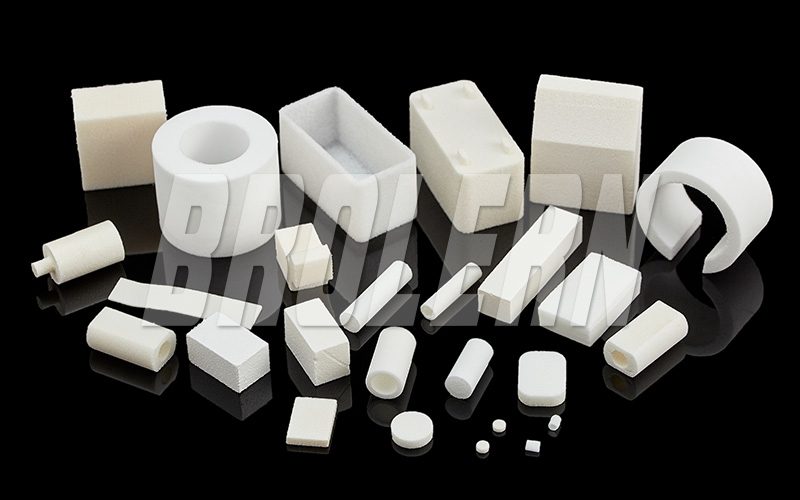
A sintered plastic filter cartridge is a rigid porous element made by bonding polymer powder — typically polyethylene (PE) or polypropylene (PP) — with heat and pressure, the same powder-metallurgy logic used for metal media but in a food-friendly polymer. The result is a mouldable, self-supporting element with uniform, reproducible pores and no loose fibres or binders. Where the process touches food, beverage or drug product, the media itself becomes part of the compliance case, which is why BROLERN offers sintered plastic in GMP / FDA grades, moulded to shape, with ratings down to 0.1µm.
What “sintered plastic” means
Fine polymer powder is pressed into the element geometry and heated just enough for the particle surfaces to fuse at their contact points. No melting into a solid block, no adhesive, no binder — the media is the polymer itself, with an interconnected network of pores running through its full thickness. Because the pore size is set by powder grade rather than a woven tolerance, the rating is uniform and repeatable from the first article to a repeat order, and the element can be moulded into discs, tubes, caps, cups or bespoke shapes that drop straight into a housing.
Why FDA / GMP grade matters here
In food, beverage and pharmaceutical duty the filter is not a neutral part — it contacts the product. That drives three requirements that sintered polymer media is well placed to meet:
- Inert, food-contact-compatible polymer. PE and PP resist most aqueous products, acids, alkalis and dilute sanitisers, and do not leach metallic ions the way some alloys can.
- No media migration. There are no loose fibres or wires to shed into the product stream — a common failure mode of wound or loose-fibre elements.
- Cleanable and sterilizable. The open, bonded pore structure tolerates back-flush, CIP and steam, so the element can be cleaned and reused rather than discarded each batch.
BROLERN states sintered plastic availability in GMP / FDA grades as part of the published plastic filters portfolio; the exact grade, resin and any documentation your validation file needs should be confirmed per order.
How sintered plastic compares with metal media
| Property | Sintered plastic (PE/PP) | Sintered metal (bronze / 316L) |
|---|---|---|
| Chemical resistance | Broad vs aqueous, acids, alkalis | Broad, plus high temp & pressure |
| Temperature limit | Lower — polymer, not metal | High — heat resistant |
| Strength / rigidity | Self-supporting, lighter | Higher structural strength |
| Cleanable / reusable | Yes (CIP, back-flush) | Yes, more cycles |
| Best fit | Food, beverage, pharma, mild duty | Hydraulic, high-temp, heavy duty |
Choose sintered plastic when chemical inertness, low weight and food-contact compatibility matter more than temperature and pressure capability; choose sintered metal when the duty is hot, high-pressure or structurally demanding. Many lines run both — a plastic element upstream for product-contact duty and metal where the element must survive the harshest stage.
Where sintered plastic cartridges are used
- Beverage — post-fermentation and pre-fill polishing where fibre shedding is unacceptable.
- Food processing — syrup, oil, dairy and ingredient streams ahead of finer stages.
- Pharmaceutical and medical — process water, WFI pre-treatment and component cleaning baths.
- Compressed air and gas — sterile-air and breather duty where the media must not shed.
- Custom porous parts — moulded caps, diffusers and vents made to a housing geometry.
Specifying tips
- State whether you need a nominal or absolute rating, and the verification method (bubble-point / challenge test) for regulated lines.
- Give the maximum operating temperature and pressure — polymer media has a lower ceiling than metal, and that decides plastic vs metal.
- For custom geometry, send a drawing or a used part; the element is moulded to match.
FAQ
What does FDA / GMP grade actually guarantee?
It means the media is produced from resins and in a process intended for food-contact and pharmaceutical use, so it is compatible with regulated lines. It is not a blanket approval for every product — confirm the specific grade and documentation your quality file requires.
How fine can a sintered plastic rating go?
Down to about 0.1µm, depending on powder grade and layering. For a critical final stage, ask for the absolute rating and how it is verified rather than relying on a nominal label.
Can I steam-sterilize a plastic element?
PE/PP media tolerates CIP and many steam cycles, but the exact temperature and cycle count depend on the grade and housing. Confirm the resin and sterilization regime with your supplier before committing the design.
Conclusion
Sintered plastic filter cartridges bring powder-metallurgy precision to food, beverage and pharmaceutical duty: reproducible ratings to 0.1µm, moulded-to-shape geometry, and an inert, fibre-free, cleanable media in GMP / FDA grades. They are the right choice where product-contact compatibility and no media migration decide the spec. Tell us your fluid, rating, temperature and geometry, and the BROLERN team will propose the grade and shape — and back it with a sample for validation.