Core points
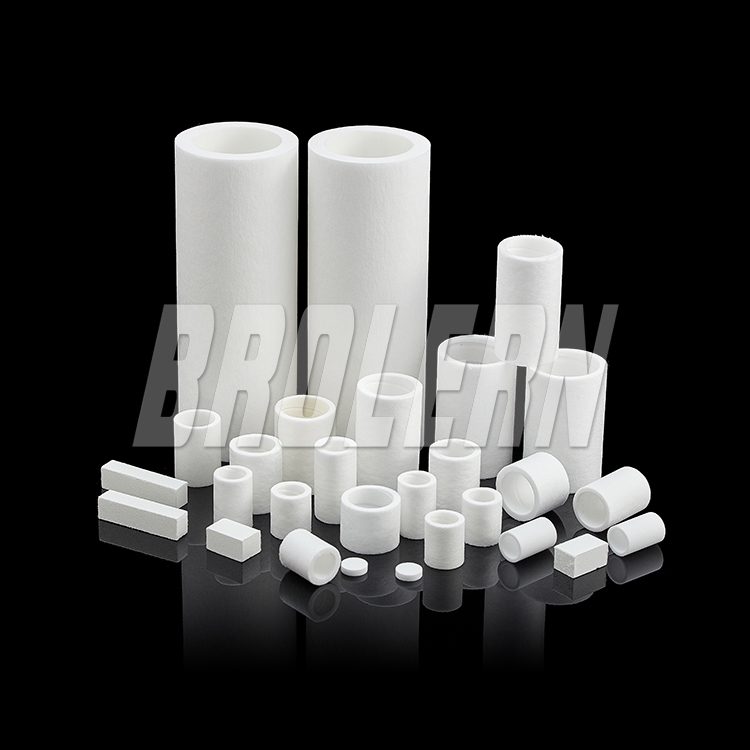
- Sintered stainless steel cartridges use multi-layer sintered mesh as the main medium: uniform surface filtration across particle sizes from 2 to 200 um, with ratings from 0.5 to 200 um machinable to customer dimensions.
- Public industry data puts sintered 316L media at up to 400 C in oxidising atmospheres and higher in reducing ones, with bronze limited to roughly 200 C [source: Aegis Ceramics porous metal data].
- Porosity for sintered metal media typically runs 28-50%, with particle-removal grades from about 0.5 um to 300 um depending on powder grade [source: Aegis Ceramics porous metal data].
- High strength and toughness suit high-pressure duty; elements are weldable and dimensionally stable under pressure pulses.
- Regeneration is excellent: after repeated cleaning, BROLERN practice recovers more than 90% of original performance.
Bronze or stainless steel - the selection table
| Max operating temperature | Bronze: about 200 C (oxidising); 316L stainless: about 400 C and above depending on atmosphere |
|---|---|
| Corrosion resistance | Both resist many acids/alkalis; 316L covers the wider chemical range incl. chloride duty |
| Pressure capability | Stainless suits high-pressure systems; welded construction does not shed media under pulses |
| Typical ratings | Bronze ~5-100 um common for pneumatic silencing; stainless 0.5-200 um |
| Cost position | Bronze is the economical default; stainless earns its premium in heat/corrosion duty |
For pneumatic exhaust silencing specifically, sintered bronze remains the industry default: typical valve-exhaust attenuation is 20-35 dB(A) with low backpressure when correctly sized [source: Ideal Bell pneumatic engineering notes]. Mechanism matters when comparing quotes - diffusion-type elements cut exit velocity (about 15-25 dB), absorptive elements convert sound in the porous lining (about 20-35 dB), and hybrid units reach 30-45 dB broadband [source: SourceBySpec pneumatic silencer encyclopedia].
Regeneration and lifetime
Pore geometry is stable and evenly distributed, so performance stays consistent through the element's life. Cleaning - backflush, ultrasonic or burn-off for steel grades - restores more than 90% of original performance in BROLERN practice, which is why sintered metal is specified where polymer media would be replaced too often to be economic.
FAQ
Bronze or stainless?
Bronze for cost-effective air/oil duties to about 200 C; 316L for corrosive media, high pressure and 400 C+.
What ratings are available?
Industry grades span roughly 0.5-300 um; BROLERN stainless mesh cartridges cover 2-200 um with 0.5 um ratings available.
Regeneration?
Backflush / ultrasonic / burn-off - more than 90% performance recovery in our practice.
Conclusion
Choose sintered metal when the duty kills polymer media - heat, pressure, corrosive chemistry or regeneration economics. Match the alloy to the atmosphere and the grade to the particle, and the element becomes a long-life capital item rather than a consumable. BROLERN manufactures both bronze and stainless lines with custom machining.