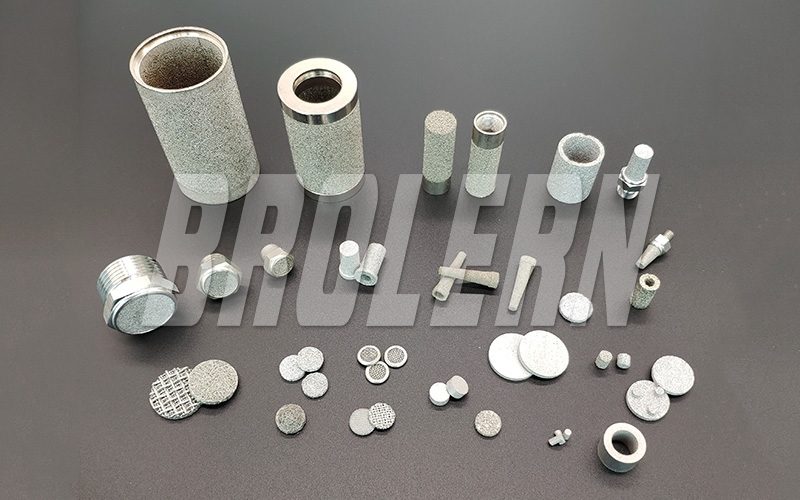
A sintered filter cartridge is a rigid porous element made by bonding metal particles — or multilayer wire mesh — together with heat and pressure, without melting them into a puddle. The result is a monolithic, three-dimensional porous structure whose pores run through the full thickness and stay put for the life of the element. If you have only seen pleated paper or spun cartridges, sintered media behaves like a different category of component: a reusable structural part rather than a disposable consumable. This article explains how sintering works, what the structure gives you, and where it beats other media.
What “sintering” actually means
Sintering is a powder-metallurgy process. Fine metal powder (stainless steel, bronze or other alloy) is pressed into a shape and heated to a temperature below its melting point. At that temperature the particle surfaces diffuse and weld together at their contact points, forming a strong, rigid skeleton with controlled, interconnected pores. No binder, no loose fibres, no adhesive — the media is the metal itself.
For filter elements, sintering is often combined with graded layering: coarse powder on the upstream face stepping down to fine powder at the downstream face. That graded structure is what gives sintered media its depth-filtration behaviour and high dirt-holding capacity at a low, stable pressure drop.
Key properties of the sintered structure
- Rigid and self-supporting. The element holds its shape under pressure, vibration and thermal cycling. A broken wire cannot open a bypass path, which is why sintered media is trusted where a failure would be costly.
- Uniform, reproducible pores. Pore size is controlled by powder grade, not by a weave tolerance, so absolute (verified) ratings down to sub-micron levels are achievable and repeatable batch to batch.
- No media migration. There are no loose fibres or wires to shed into the fluid — important in hydraulic, food and pharmaceutical duty.
- Cleanable and reusable. Because the pores are open and bonded, contaminants can be flushed, soaked or ultrasonically removed, returning the element close to its original flow.
Sintered vs the media it is often compared with
| Property | Woven wire mesh | Pleated paper / melt-blown | Sintered metal |
|---|---|---|---|
| Structure | Crossed wires (surface) | Fibrous sheet / web | Bonded porous body (depth) |
| Rigid / self-supporting | Partial | No | Yes |
| Absolute rating | Hard to hold fine | Possible (pleated) | Reproducible, fine |
| Cleanable / reusable | Yes, but traps in weave | No (disposable) | Yes, many cycles |
| Media migration | Broken-wire risk | Fibre-shed risk | None |
This is why sintered media is specified where precision, reusability and structural integrity matter more than the lowest unit price. Our sintered and custom solutions team translates a mesh or performance spec into a bonded-element design when life-cycle cost is the decision.
Where sintered cartridges are used
- Hydraulic and lubrication systems — rigid, cleanable elements that protect pumps and servo valves.
- Gas distribution — sintered bronze plates and tubes for fluidization, aeration and sparging.
- Food and pharmaceutical duty — 316L sintered stainless with a validated, documented cleaning regime and fibre-free surface.
- Custom porous components — silencers, breathers, flow restrictors and parts made to drawing or sample.
What to ask a sintered-filter supplier
- The absolute rating with a beta value (β1000) and the verification method (bubble-point or challenge test).
- The alloy and grade (316L for most food / pharma / corrosive duty).
- The recommended cleaning method for your foulant, and how many cycles to expect.
- Whether the shape can be customized to your housing or a bespoke geometry.
FAQ
Is a sintered filter the same as a mesh filter?
No. Woven mesh is a screen of crossed wires; sintered media is a diffusion-bonded porous body whose pores run through the full thickness. Sintered gives finer, more reproducible ratings and is cleanable without the trapped-in-weave problem.
Can a sintered cartridge be reused?
Yes. Elements are cleaned by backflush, CIP, ultrasonic or chemical soak and reused for many cycles, which is the main reason sintered beats disposable media on total cost of ownership in continuous duty.
How fine can a sintered rating go?
Sintered metal supports absolute ratings from coarse (tens of microns) down to sub-micron levels, depending on powder grade and layering. Specify the absolute rating you need and the supplier should verify it.
Conclusion
A sintered filter cartridge is a rigid, bonded porous component — not a woven screen or a disposable sheet. Its strength, reproducible absolute rating, freedom from media migration and cleanability make it the right choice where precision and life-cycle cost decide the spec. Tell us your fluid, rating and duty, and our sintered solutions team will propose the grade, shape and cleaning procedure — and back it with a sample.