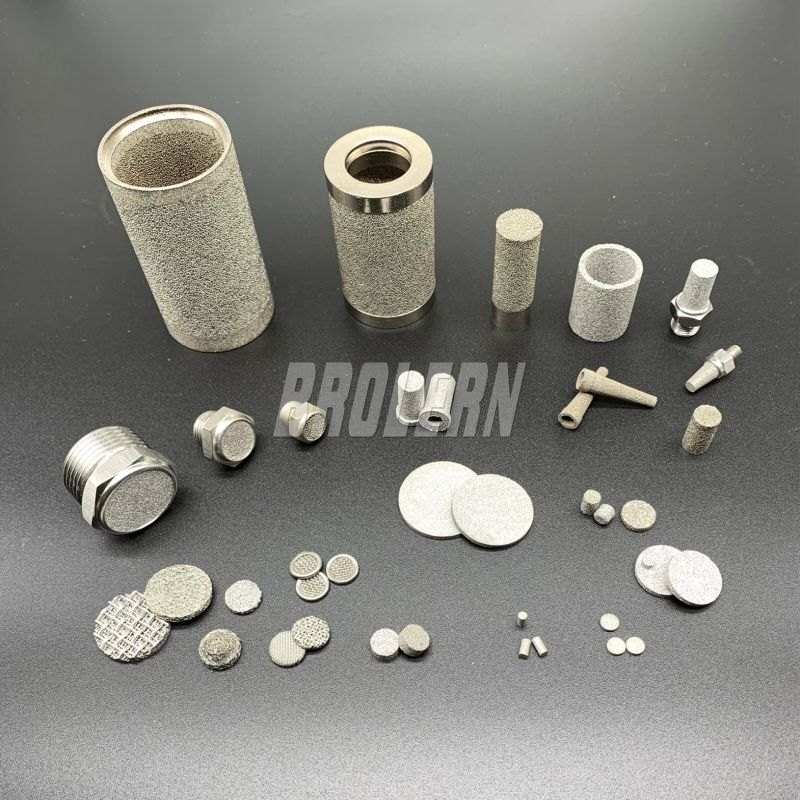
Filtration is only the most visible use of a capability BROLERN has built around powder metallurgy: the same pressing-and-sintering process that makes a filter cartridge also makes a wide range of porous and structural components to a customer's drawing or sample. Because the part is formed from powder rather than machined from stock, complex porous geometries can be produced in volume without the scrap and tooling cost of cutting metal. This article explains the process and where sintered components earn their place beyond filtration.
The process in brief
- Powder selection — the alloy or polymer grade sets the final porosity, strength and corrosion behaviour.
- Compaction — powder is pressed into the target shape, including non-cylindrical forms a standard cartridge cannot take.
- Sintering — the pressed part is heated below melting so particles diffusion-bond into a rigid, porous or solid body.
- Finishing — where needed, the part is sized, machined or joined, and validated against the drawing.
The same route works for metals (stainless, bronze, titanium) and polymers (PE / PP), so the media can be matched to the duty rather than the other way round.
What gets made beyond filters
| Component | What it does |
|---|---|
| Porous spargers / aerators | Distribute gas evenly into a liquid for aeration or mixing |
| Breathers and tank vents | Let air move while stopping dust and moisture ingress |
| Flow restrictors / silencers | A controlled porous path meters or quiets flow with no moving parts |
| Structural porous parts | Shaped porous components inside devices and instruments |
These are the same principle as a filter — a deliberately porous, bonded body — applied where the job is to meter, distribute or vent rather than to remove particles.
Why specify a custom sintered part
- Geometry freedom — discs, plates, caps, tubes and shaped parts that drop straight into an assembly.
- Material match — stainless, bronze, titanium or polymer chosen to survive the fluid and temperature.
- Volume consistency — the rating and shape repeat batch to batch because they are set by the process.
- Lower scrap than machining — complex porous forms are made, not cut.
The drawing-to-sample path
Custom work starts with what you have: a drawing, a sample, or a description of the function. BROLERN confirms the material and porosity, produces a first part, and — once it qualifies on your line — scales to repeatable batches. See the custom solutions page for the full path, and our buyer-side guides on sending a drawing or sample for quotation.
Specifying a custom sintered part
- Provide the drawing or sample and the function the porous part must perform.
- State the fluid, temperature, pressure and any cleanliness or regulatory needs.
- Give the porosity or flow target, or let the engineer derive it from the duty.
- Note the volumes so the part is specified for both first article and production.
FAQ
Is a custom sintered part more expensive than a standard cartridge?
Tooling and first-article work add cost up front, but because the part is formed from powder rather than machined, volume production is often cheaper than cutting a complex porous shape from stock — and you get a geometry that off-the-shelf parts cannot provide.
Which material should a custom part use?
It depends on the fluid, temperature and corrosion duty: polymer for clean, inert, mild-chemical service; bronze for economical air/water/oil; stainless for heat, pressure and general corrosion; titanium for chlorides and seawater. The engineer confirms the grade against your chemistry.
How do I start a custom project?
Send a drawing or sample and describe the function. BROLERN confirms material and porosity, makes a first part, and scales to production once it qualifies on your line.
Conclusion
Powder metallurgy is the capability behind BROLERN's filters and a great deal more: sintered porous metal and plastic parts — spargers, breathers, restrictors, shaped components — produced to drawing or sample in materials matched to the duty. Tell us the function and send a drawing or sample, and the BROLERN team will confirm the material, make the first part, and scale it to repeatable batches.