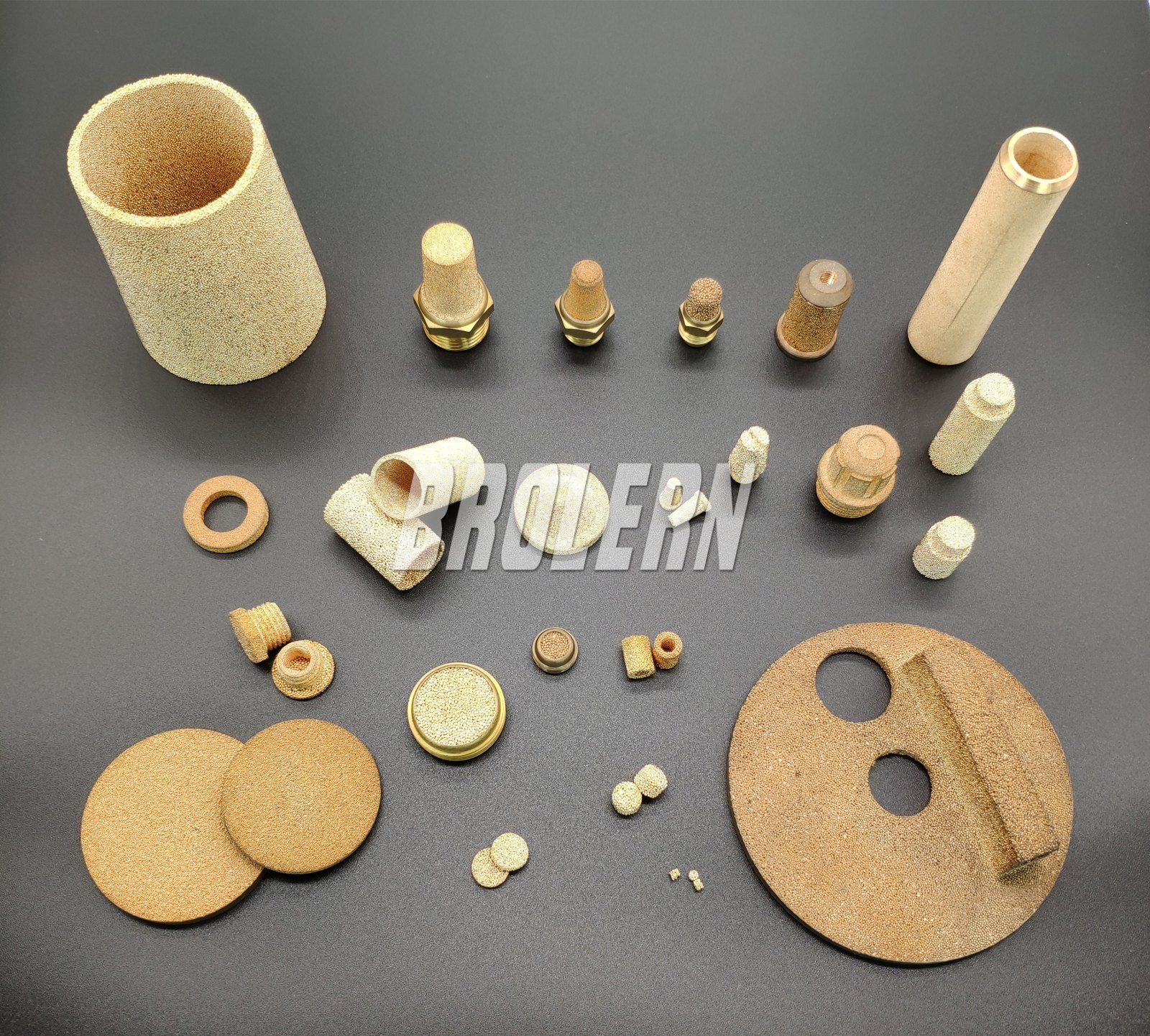
Air escaping from a pneumatic cylinder or valve vent is loud because it expands through a small orifice at speed. A muffler tames that noise by forcing the exhaust to spread through a porous body instead of a single jet — and sintered bronze is one of the most proven materials for the job. Being a rigid, porous metal, it dissipates flow with no moving parts, resists the vibration and oil mist of pneumatic lines, and is cheap enough to be a fit-and-forget component. This article focuses on the bronze version and the family of porous bronze parts around it.
How a sintered bronze muffler works
The muffler is a small porous bronze element in the exhaust path. Instead of the air blasting out of one hole, it is distributed across the whole porous face, so the kinetic energy is spread over a large area and the peak velocity — and therefore the noise — drops sharply. There are no diaphragms, no springs, nothing to wear: air simply passes through the pores. That is why bronze mufflers are trusted on compressors, actuators and tools that cycle constantly.
Why bronze for this job
- No moving parts — nothing to fail under continuous cycling.
- Rigid porous metal — holds its shape and pores under vibration and pressure.
- Oil-mist tolerant — the open porous structure handles the oil-laden exhaust of lubricated pneumatics.
- Economical — a simple pressed-and-sintered part at low cost.
- RoHS compliant — BROLERN's bronze media is RoHS compliant.
Beyond mufflers: porous bronze pneumatic parts
The same sintered bronze technology that quiets exhaust also serves other pneumatic functions, because a precisely porous metal can meter, distribute or hold back flow on purpose:
- Breathers and tank vents — let air move while stopping dust and moisture ingress.
- Flow restrictors / speed controls — a controlled porous path sets a flow rate without a needle valve.
- Aerators and spargers — distribute gas evenly into a liquid (covered in our broader bronze filters article).
- Silencing at valves and tools — the core muffler function across the air system.
Bronze muffler vs the broader muffler range
| Aspect | Sintered bronze muffler | Other porous-metal mufflers |
|---|---|---|
| Cost | Low — the economical choice | Varies with alloy |
| Duty | General air exhaust, tools, compressors | Matched to specific lines |
| Form | Compact threaded element | Threaded, inline, speed-control |
| Maintenance | Fit-and-forget, replace if clogged | Similar |
Bronze is the economical default for general pneumatic exhaust silencing; for the full range of sizes, thread forms and speed-control (throttling) mufflers, see the mufflers overview. For sizing by thread and flow, our muffler selection guide walks the steps.
Specifying a bronze muffler
- Match the thread (commonly M5 up to larger ports) to the valve or cylinder vent.
- Size for the exhaust flow so the muffler does not become the bottleneck.
- Confirm the working pressure and ambient conditions are within the bronze element's range.
- If the line is hot, corrosive or food-contact, discuss an alternative media with the supplier.
FAQ
Do bronze mufflers restrict the cylinder's speed?
A correctly sized muffler adds only a small, deliberate restriction — that is part of how it works — but it should not stall the actuator. Size for the exhaust flow; if precise speed control is needed, use a speed-control (throttling) muffler rather than a plain one.
Are they reusable or disposable?
They are fit-and-forget components. If the porous face clogs with oil-carbon or debris, replace the muffler; the element is not normally cleaned in the field.
Will a bronze muffler work on a lubricated air line?
Yes. The open porous bronze structure tolerates the oil mist of lubricated pneumatics far better than fine fibrous media would, which is a big reason bronze is used here.
Conclusion
Sintered bronze mufflers are the economical, fit-and-forget way to quiet pneumatic exhaust: a rigid porous metal element with no moving parts that spreads the escaping air and cuts the noise, and the same technology underpins breathers, restrictors and spargers across the air system. Tell us your thread, flow and pressure, and the BROLERN team will confirm the right muffler or porous bronze part — and supply a sample.