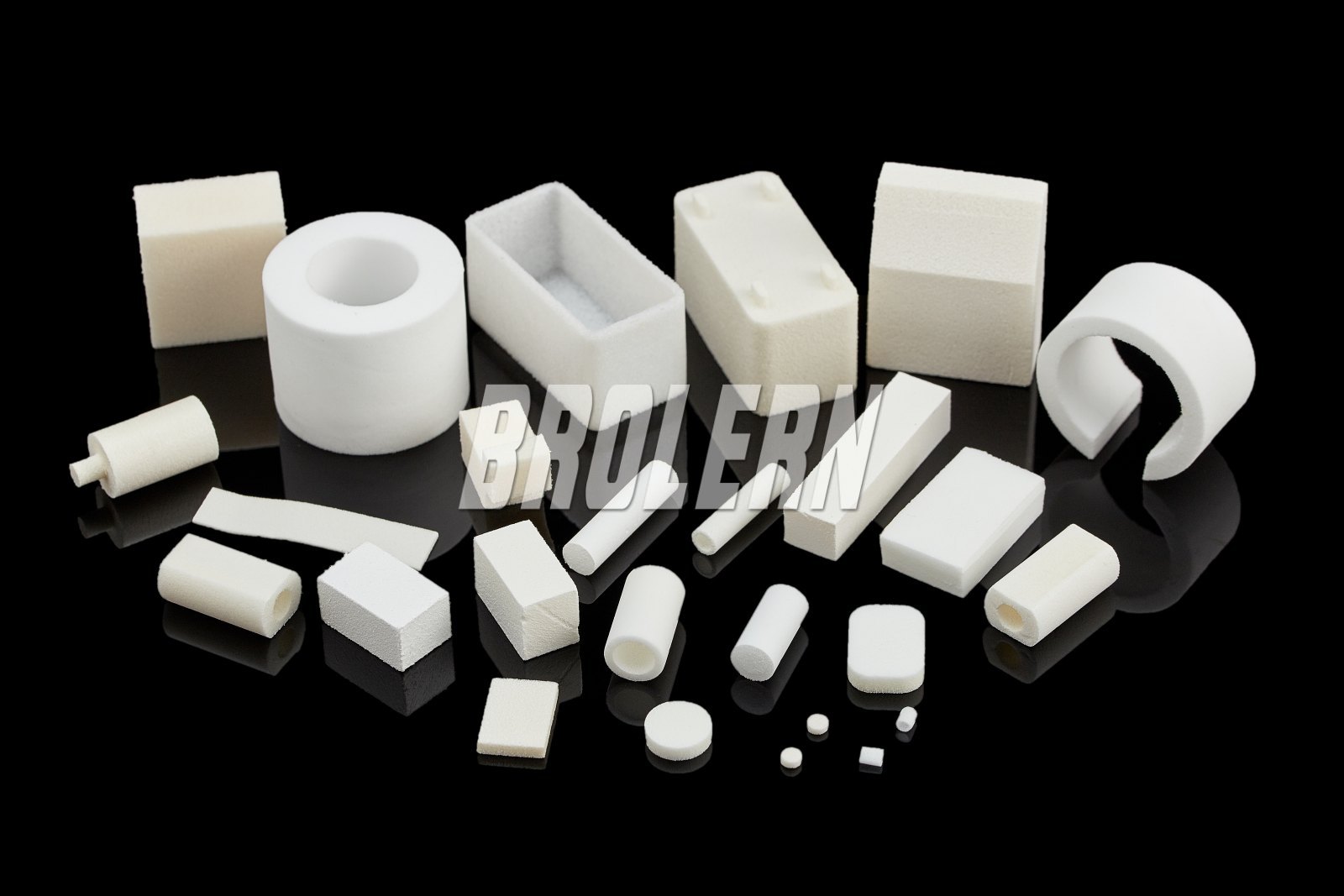
A sponge filter cartridge is a porous polymer element built as one continuous, open-cell structure rather than a web of loose fibres or a stack of separate layers. Because the media is a single bonded body, it holds an exceptionally high void fraction — porosity above 90% is typical — while having nothing loose to release into the stream. That combination, high flow at low pressure drop and zero media migration, is exactly what makes sponge media attractive for water, compatible chemicals and any line where a stray fibre would be a defect. This article explains how sponge cartridges work, where they belong, and how they compare with the other porous media BROLERN offers.
What “sponge” actually means here
The term describes the structure, not a household cleaning pad. The element is a sintered or otherwise fused porous polymer with an interconnected network of pores throughout its wall. Feed passes through that network: large particles are caught near the surface, smaller ones deeper in, and the structure keeps a high open area so flow is not choked as quickly as a dense surface screen would be. Because the whole body is bonded, there are no binders to leach, no fibres to shed and no seams to open — the element is one piece from end to end.
Why high porosity matters
Porosity is the share of the media that is open space. Above 90%, the element presents a very large, continuous flow path, so it delivers high throughput at a low differential pressure. In practice that means:
- More flow per element — you get the throughput you need without stacking extra housings.
- Lower energy cost — the pump or compressor works against less resistance.
- Slower pressure-drop rise — the deep, open structure holds more contaminant before the change-out point.
The defining advantage: no media migration
Many fine cartridges are made from loose or wound fibres. Under shock, pulsing or simply over time, those fibres can work loose and travel downstream — a real defect source in water, coating, ink and process streams. A bonded sponge element has nothing to shed, so what you filter out stays in the element. Choose sponge (or any bonded media) wherever media migration is unacceptable.
Where sponge cartridges fit best
- Water and compatible aqueous streams — pre-filtration and polishing where high flow and clean media matter.
- Pre-filtration ahead of finer stages — protecting membranes, pumps and final elements cheaply.
- Process fluids compatible with the polymer — confirm the chemistry, concentration and temperature before committing the media.
- Any line that cannot tolerate stray fibres — coatings, inks, and clean process loops.
Sponge vs the other porous media
| Property | Sponge (porous polymer) | Sintered plastic | Fibre (PP / glass) |
|---|---|---|---|
| Structure | Bonded open-cell polymer | Bonded porous plastic | Bonded fibre web |
| Porosity / flow | Very high (>90%), low ΔP | Moderate–high | Moderate |
| Media migration | None | None | None (bonded) |
| Typical strength | Good, self-supporting | Good, mouldable shapes | Good |
| Best role | High-flow, no-shedding depth duty | Precision-rated, moulded parts | Fine nominal polishing |
The three are complementary, not rivals: sponge for high-flow no-shedding depth filtration, sintered plastic where a precise, often moulded geometry and FDA/GMP grades are wanted, and fibre media for fine nominal polishing. Where the fluid is hot, corrosive or must be cleaned and reused, move to sintered metal.
Specifying a sponge cartridge
- State the fluid, concentration and temperature so compatibility can be confirmed per grade — “polymer” spans a family, not a single chemical resistance.
- Give the micron target and whether a nominal or verified retention is needed for the downstream component.
- Match length, diameter and end connections to the existing housing so the element drops in without rework.
- Treat the rating as a nominal depth class unless a verified cut is specified; follow a finer absolute stage where a hard cut matters.
FAQ
Is a sponge cartridge the same as a melt-blown or wound cartridge?
No. Melt-blown and wound elements are built from fine fibres or yarn and can shed or shift under shock, whereas a sponge cartridge is a single bonded porous body with nothing loose to release. The no-shedding property is the reason to pick it.
Can I clean and reuse a sponge cartridge?
It depends on the fluid and how loaded the element is. Sponge media can often be flushed or soaked to recover flow for compatible, non-fouling streams, but for critical or fouling duty treat it as a replaceable element and confirm the cleaning approach with the supplier.
How do I know the polymer is compatible with my fluid?
Send the exact fluid, concentration and temperature. Compatibility is grade-specific, so the media is checked against your chemistry rather than assumed from a generic material name.
Conclusion
Sponge filter cartridges earn their place wherever you need high flow at low pressure drop and cannot tolerate any media migration: a bonded, open-cell polymer body above 90% porosity that sheds nothing and flows freely. Tell us your fluid, micron target and housing, and the BROLERN team will confirm the media and send a sample so you can qualify it on your own line.