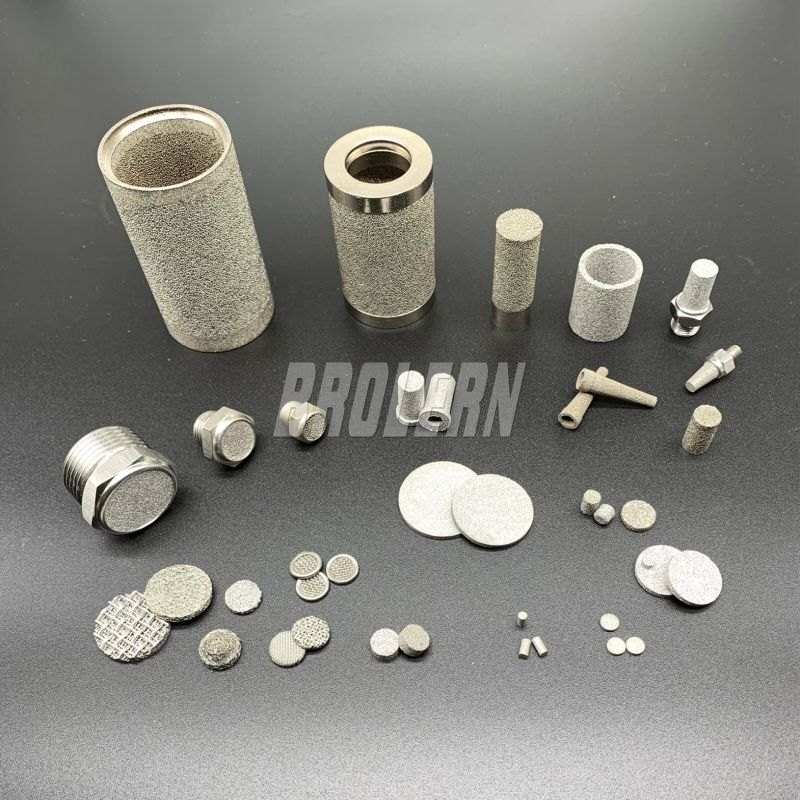
When a filtration job runs hot, at pressure, or against a fluid that attacks ordinary metals, the media choice stops being about micron rating alone and becomes a materials decision. Sintered stainless steel (typically 316L) and titanium are the two sintered-metal options BROLERN offers for harsh duty, and both are built the same way: metal powder pressed and diffusion-bonded into a rigid, uniform-pore element that can be cleaned and reused. This article covers what each brings, and how to decide between them.
What sintered metal gives you
- Rigid, self-supporting structure — no cage or core needed just to hold the shape.
- Uniform, reproducible pores — the rating is a function of the process, not a weave tolerance, so it repeats batch to batch.
- Cleanable and reusable — contaminants are flushed, soaked or back-pulsed out and the element returns close to its original flow.
- Heat and pressure tolerant — far above the ceiling of any polymer media.
- No media migration — a bonded metal body sheds nothing.
Sintered stainless steel (316L)
316L is the workhorse for corrosive and high-temperature service. It is rated across roughly 2 to 200 µm, resists a broad range of chemicals, tolerates heat and pressure that would destroy polymer or fibre media, and — critically — can be cleaned and returned to service many times. That clean-and-reuse cycle is what wins on total cost of ownership: a 316L element that costs more up front often beats a cheap disposable over dozens of cleaning cycles. It is the usual choice for hydraulic, process, food and pharmaceutical contact where validated cleaning matters.
Titanium
Titanium enters the decision when stainless would be at its limit. Its standout property is resistance to chloride and seawater corrosion — environments where even 316L can be attacked — combined with a high strength-to-weight ratio and excellent high-temperature behaviour. Where the line is seawater, brackish, or carries aggressive chlorides, or where weight and temperature both matter, titanium is the metal that keeps working after stainless would fail. It is the right call for marine, offshore, desalination-adjacent and certain chemical duties.
Stainless vs titanium at a glance
| Property | Sintered 316L stainless | Sintered titanium |
|---|---|---|
| Corrosion resistance | Broad chemical & general duty | Excels in chloride / seawater |
| Temperature | High | Very high |
| Strength | High | High, lighter per unit strength |
| Clean / reuse | Many validated cycles | Many validated cycles |
| Relative cost | Moderate | Higher (bought for the environment) |
| Pick it when | Heat, pressure, general corrosion | Chlorides, seawater, extreme duty |
When metal beats polymer outright
- The fluid temperature or pressure is beyond what polymer media can take.
- The element must be cleaned and reused to be economical.
- A verified, reproducible rating matters and the body must shed nothing.
- The duty is corrosive enough that only stainless or titanium survives.
Specifying a sintered-metal element
- State the fluid, concentration, temperature and pressure — these decide the alloy.
- Give the micron rating and whether it must be verified (bubble-point or challenge test) for the downstream component.
- Confirm the cleaning method you will use (back-pulse, soak, ultrasonic) so the element is specified for it.
- Match geometry and end fittings to the housing.
FAQ
Is titanium always better than stainless?
No. Titanium is the choice where stainless would corrode — chiefly chlorides and seawater — or where extreme temperature and weight matter. For general hot, pressurized or corrosive duty, 316L is the economical default; pay for titanium only when the environment needs it.
Can a sintered metal filter really be reused?
Yes. Because the body is rigid and bonded, contaminants can be flushed, soaked or back-pulsed out and the element returned close to its original flow across many cycles, which is why it wins on life-cycle cost for demanding service.
How is the micron rating verified on a sintered metal element?
A controlled-pore, bonded structure can be tested to a verified absolute rating — typically by bubble-point or a multi-pass challenge — so the cut is a measured quantity rather than a nominal class. Ask for the beta value and test method.
Conclusion
Sintered stainless (316L) and titanium are the same technology in two alloys: both rigid, heat- and pressure-resistant, cleanable and shedding-free. Choose 316L for general hot, pressurized and corrosive duty; choose titanium where chlorides, seawater or extreme conditions would defeat stainless. Tell us your fluid, temperature, pressure and rating, and the BROLERN team will recommend the metal — and send a sample to confirm fit on your line.