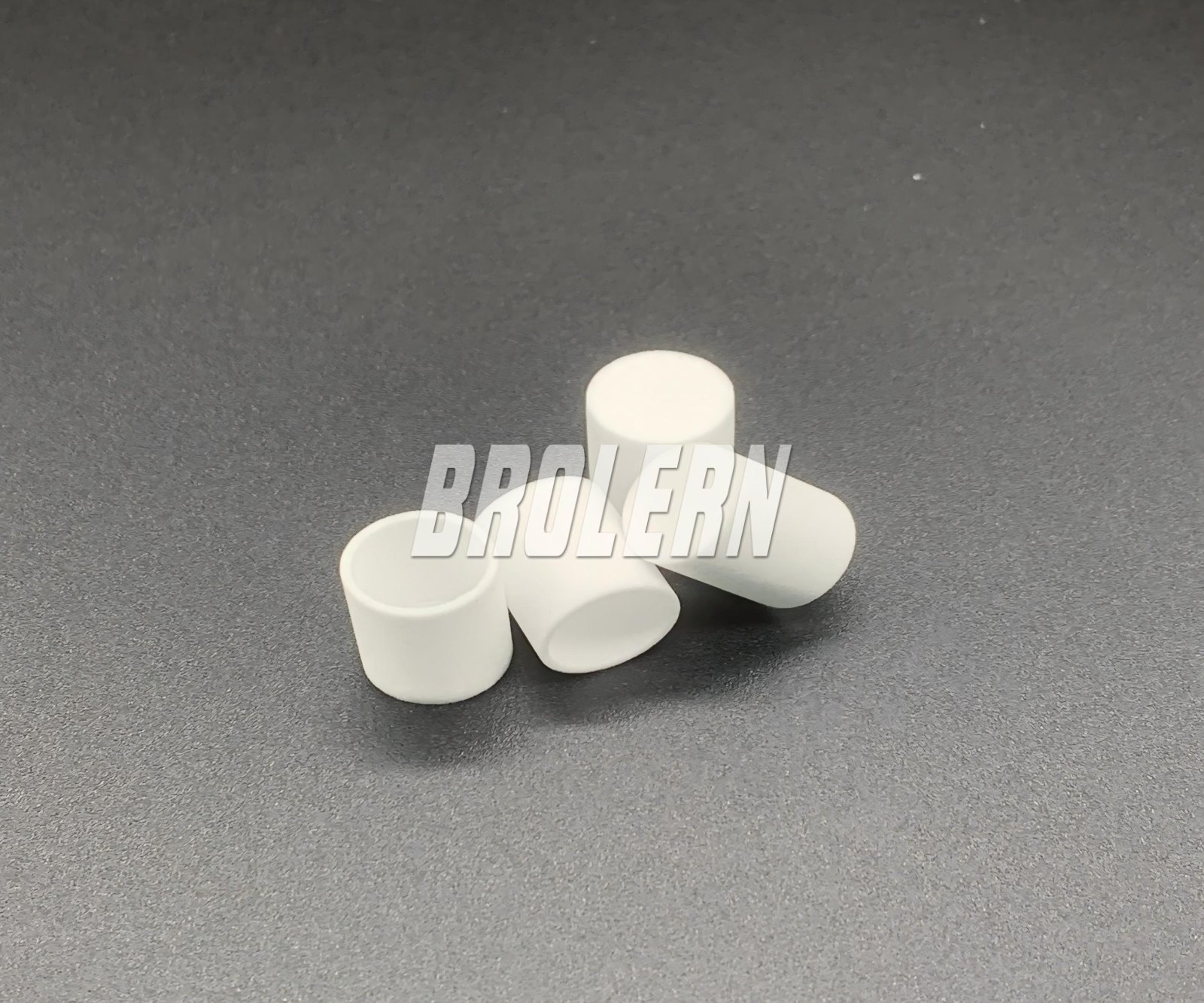
A sintered filter cartridge is a rigid, porous element made in one piece by pressing fine metal or polymer powder and then heating it just below its melting point so the particles fuse — diffusion-bond — into a solid body with a controlled, interconnected network of pores. Nothing is woven, wound or glued: the filter is the material itself. Because the structure is the part, a sintered element is self-supporting, holds a reproducible pore size, sheds no media, and — in metal — can be cleaned and reused. This article explains the process, the materials BROLERN offers, and where sintered media earns its place.
How sintering actually works
The starting point is a precisely graded powder. The powder is pressed into the element shape (a tube, disc, cap or plate), then sintered in a controlled furnace where particles at their contact points grow necks and bond. The result is a monolithic porous body whose pore size is set by the powder grade and the process, not by a weave tolerance. That is the key difference from a screen or a wound element: the rating repeats batch to batch because it is a property of how the part was made, not how a mesh happened to be woven.
The materials, and what each is for
| Aspect | Sintered plastic (PE / PP) | Sintered bronze | Sintered stainless (316L) | Sintered titanium |
|---|---|---|---|---|
| Best for | Clean, inert, mouldable parts | Air, water, oil, pneumatic | Heat, pressure, corrosion, reuse | Chlorides, seawater, extreme duty |
| Finest rating | ~0.1 µm | Coarse–fine | ~2 µm | ~2 µm |
| Temperature | Moderate (polymer) | Moderate | High | Very high |
| Cleanable | Limited | Often | Many cycles | Many cycles |
In practice these are complementary: pick sintered plastic where the part must be clean, inert and possibly moulded into a non-standard shape; pick sintered bronze for economical air, water and oil service; move to sintered stainless when heat, pressure or corrosion dominate and the element must be cleaned and reused; reserve titanium for chloride and seawater environments where even 316L would be attacked. Sponge (porous polymer) is the high-flow, no-shedding cousin used where throughput and clean media matter most.
Why engineers choose sintered media
- Uniform, reproducible pores — the rating is a function of the process, so it repeats across batches.
- No media migration — a bonded body sheds nothing into the stream.
- Rigid and self-supporting — no cage needed just to hold the shape.
- Cleanable and reusable (metals) — contaminants are flushed, soaked or back-pulsed out and the element returns close to its original flow.
- Temperature and pressure tolerant (metals) — far beyond any polymer or fibre media.
Where sintered cartridges are used
- Process and hydraulic filtration — where a verified, reusable rating matters.
- Food, beverage and medical contact — in clean, inert, often moulded plastic grades.
- Pneumatic and compressed-air systems — as the porous core of mufflers, breathers and restrictors.
- Chemical, marine and corrosive lines — in stainless or titanium.
Specifying a sintered element
- State the fluid, concentration, temperature and pressure — these decide the material.
- Give the micron rating and whether it must be a verified (bubble-point or challenge-tested) absolute class.
- If the part is non-cylindrical, supply a drawing or sample — see our custom solutions page.
- Match geometry and end fittings to the housing so the element drops in without rework.
FAQ
Is sintering the same as welding or casting?
No. Sintering bonds powder particles at their contact points below the melting point, leaving a controlled pore network. Casting makes a solid (non-porous) part; welding joins separate pieces. Only sintering produces a rigid body that is mostly open, interconnected pore space.
Can a sintered metal filter really be reused?
Yes. Because the body is rigid and bonded, contaminants can be flushed, soaked or back-pulsed out and the element returned close to its original flow across many cycles — which is why metal sintered media wins on life-cycle cost for demanding service.
How is the micron rating verified?
A controlled-pore bonded structure can be tested to a verified absolute rating, typically by bubble-point or a multi-pass challenge, so the cut is a measured quantity rather than a nominal class. Ask for the beta value and the test method.
Conclusion
A sintered filter cartridge is a single bonded porous body — metal or polymer — whose pores are a product of how it was made, not how a mesh was woven. That gives uniform, repeatable ratings, zero media migration, and, in metal, clean-and-reuse durability. Tell us your fluid, temperature, pressure and rating, and the BROLERN team will recommend the material and send a sample so you can qualify it on your own line.