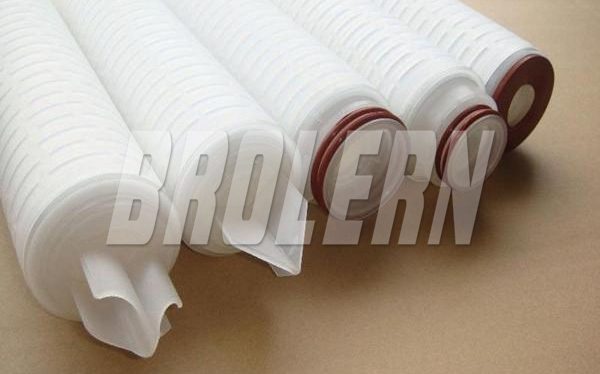
“5 micron” on a cartridge datasheet can mean three very different things. Two elements both labelled 5µm can retain very different particle sizes — and if the downstream component is sensitive, that gap is the difference between protection and a failure. This article explains the three ways a micron rating is expressed (nominal, absolute and beta ratio), how each is verified, and what to ask a supplier so you know exactly what you are buying.
Nominal rating
A nominal rating is a broad efficiency class, not a guaranteed cut. It typically means the element retains a high percentage (often around 98%) of particles of the stated size — but a meaningful share of that size still passes. Nominal ratings are common on melt-blown, wound and many fibre cartridges because those media have a distribution of pore sizes rather than a single, controlled opening.
- Good enough for: pre-filtration and bulk-sediment roles where a hard cut is not critical.
- Not good enough for: protecting a component with a tight particle tolerance.
Absolute rating
An absolute rating is the particle size at which the element is verified to retain essentially all particles of that size and larger — a defined cut, tested rather than asserted. Sintered and pleated media, with controlled and reproducible pore structures, are the usual candidates for a true absolute rating. Where a datasheet gives an absolute rating, it should also state the test method.
Beta ratio
The beta ratio (β) is the engineering measure behind an absolute rating. For a given particle size x, βx is the number of particles of that size upstream of the filter divided by the number downstream:
βx = (upstream count) ÷ (downstream count)
- β = 2 means 50% of that size is captured.
- β = 200 is roughly 99.5% efficient — often quoted as the “absolute” point for that size.
- β = 1000 or higher means 99.9%+ efficiency, used for the most critical stages.
Asking for a beta value with the verification method turns a marketing micron number into an engineering specification. Standards such as ISO 16889 (multi-pass) and the bubble-point method underpin these tests in established practice.
How ratings are verified
| Method | What it does |
|---|---|
| Multi-pass challenge test | Runs a controlled contaminant feed and counts particles in/out to derive the beta ratio (ISO 16889 practice) |
| Bubble-point test | Measures the pressure at which the largest pores open — a non-destructive integrity check for a bonded element |
| Particle counting | Counts upstream/downstream particles at the target size to confirm efficiency |
What to ask your cartridge supplier
- Is the quoted rating nominal or absolute? If absolute, what is the beta value and at what particle size?
- What test method verifies it (multi-pass, bubble-point, challenge), and is a certificate available?
- Is the rating reproducible batch to batch — i.e. is the pore structure controlled by the process rather than a weave tolerance?
This is why bonded media is chosen for critical stages: a sintered or pleated element with a verified absolute rating and a beta value gives you a number you can design around. For the selection side, see how to choose the right micron rating and the 7-media decision matrix.
FAQ
Does a higher micron number mean a coarser filter?
Yes — micron rating is the particle size the element targets, so a larger number means larger particles are retained and finer ones pass. But the type of rating (nominal vs absolute) matters more than the number alone.
Is an absolute rating always necessary?
No. For pre-filtration and bulk sediment a nominal rating is fine and cheaper. Reserve verified absolute ratings for stages that protect a sensitive or critical component.
Can a nominal-rated media be given an absolute rating?
Only if its structure supports one. Bonded, controlled-pore media (sintered, pleated membrane) can be tested to an absolute rating and beta value; loose or graded media (wound, melt-blown) are normally quoted nominal.
Conclusion
A micron number only means something once you know whether it is nominal, absolute or a beta ratio — and how it was verified. For critical stages, specify a verified absolute rating with a beta value and test method, which bonded sintered or pleated media can deliver. Tell us the particle size you must stop and the component you are protecting, and the BROLERN team will recommend a media and back the rating with a sample and test data.