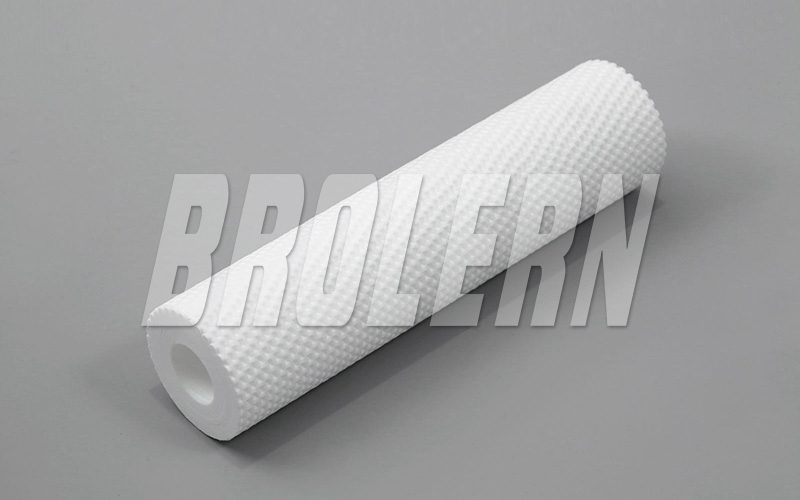
Powder metallurgy (PM) is the process behind every sintered filter we make — press metal powder into a shape, then heat it below the melting point so the particles diffusion-bond into a rigid, porous body. The same process that produces a sintered filter cartridge also produces a much wider family of porous and solid metal components: silencers, breathers, flow restrictors, aeration elements and bespoke parts made to your drawing or sample. This article looks at the PM parts side of the business and why “one process family, endless geometries” is more than a slogan.
Why powder metallurgy suits porous parts
PM gives you control that casting or machining cannot match: the pore size is set by powder grade, the porosity by compaction, and the geometry by the tool — all in one step, with no secondary drilling or weaving. That combination is what makes it the default process for parts where the pores are the function:
- Controlled, reproducible porosity — pore size is a powder-selection decision, repeatable batch to batch.
- Complex geometry in one operation — flanges, steps, threads and internal features formed in the tool.
- Material flexibility — bronze, stainless steel and other alloys, each with its own corrosion and strength profile.
- Near-net shape — little machining afterward, which keeps cost down on custom parts.
PM parts beyond filtration
| Part | What the pores do | Typical use |
|---|---|---|
| Silencers / mufflers | Diffuse and stage down exhaust flow | Pneumatic and automotive exhaust (silencer range) |
| Breathers / vents | Let air pass, block liquid and dust | Gearboxes, reservoirs, enclosures |
| Flow restrictors | Meter flow through a fixed pore | Damping, bleed and calibration |
| Aeration / fluidization elements | Release gas as fine, uniform bubbles | Ozone, aeration, sparging (bronze) |
| Sensor / valve protection | Shield a port from debris | Instrumentation, actuators |
Each of these uses the same lever — a tuned porous path — to turn pressure and flow into a controlled, quiet or protective function. The design question is always the same: what pore size, porosity, alloy and geometry deliver the flow and pressure behaviour you need.
Materials: bronze, stainless and beyond
- Sintered bronze — the general-purpose porous metal: easy to machine, good corrosion resistance, the default for filters, silencers and fluidization elements.
- Sintered stainless steel (e.g. 316L) — where strength, temperature or corrosive duty demand it; cleanable and reusable.
- Other alloys — selected for specific corrosion, magnetic or strength requirements.
The powder metallurgy parts line and the custom filter elements line share the same tooling and process know-how, so a part can be specified for its porous behaviour, its structural behaviour, or both.
Custom, from tooling in house
Because BROLERN keeps its mould sets and process in house, custom porous parts are practical rather than expensive to develop:
- Send a drawing or a used part — we quote to match it, including reverse-engineering an existing component.
- Matched tooling — the pore structure and geometry are fixed by the tool, so the first article and the repeat order are the same.
- Batch consistency — a stable, repeatable process is why pore distribution stays uniform across a production run.
- Export packing — finished parts packed for international shipment.
If you are replacing a proprietary porous part or developing a new one, a used sample is often the fastest brief — it carries the geometry, the pore feel and the duty in a single object.
FAQ
What is the difference between a porous and a solid PM part?
Pore size and porosity. A porous part is intentionally under-compacted and graded so fluid passes through; a solid PM part is pressed to near-full density for structural strength. Many parts blend both — a porous section for flow inside a solid frame.
Can you make a part I already have, with no drawing?
Yes. Send a used sample; we reverse-engineer the geometry and match the porous behaviour, then quote to reproduce it.
What is the minimum order for a custom PM part?
It depends on the tooling and geometry. Send the drawing or sample for a quote — matched in-house tooling is what keeps even custom porous parts economical to repeat.
Conclusion
Powder metallurgy is the single process behind the whole porous portfolio — filters, silencers, breathers, restrictors and aeration elements — and its strength is turning a pore specification into a repeatable metal part. With tooling in house and a stable process, custom porous components are made to your drawing or a used sample with consistent batch behaviour. Send us your part, your flow and pressure targets, and the BROLERN sintered and custom solutions team will take it from sample to production.