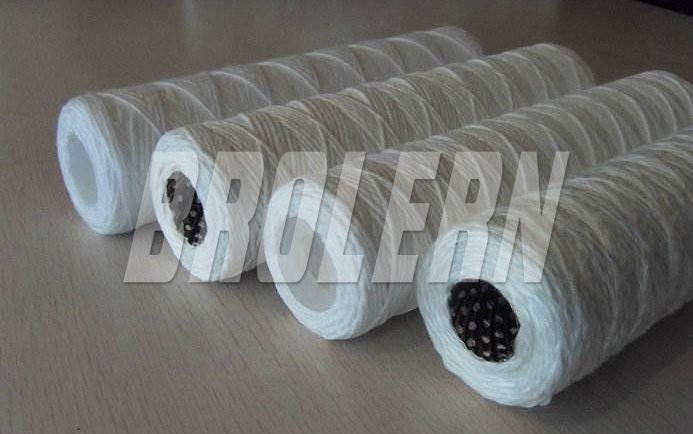
A wound filter cartridge — usually called string-wound or spun-wound — is built by winding yarn around a perforated core, layer after layer, to form a deep bed of fibre. Because the winding gets tighter toward the core, the cartridge grades itself from coarse on the outside to fine on the inside, giving it depth-filtration behaviour in a very low-cost element. It is one of the most widely used industrial cartridges precisely because it is cheap and handles dirty feed well. This article explains how it works, where it belongs, and the one risk you have to manage.
How a string-wound cartridge filters
Yarn (cotton, rayon, polypropylene or blends) is wound on a core so the outer layers are open and the inner layers are tight. Feed enters from the outside and works inward: large particles are caught in the loose outer turns, smaller ones deeper in, and the finest near the core. That graded, honeycomb structure spreads the contaminant load through the full depth of the element, so it holds more dirt before the pressure drop climbs than a same-rated surface filter on the same feed.
Where wound cartridges earn their place
- Bulk sediment removal — sand, rust and suspended solids in process and potable water, ahead of finer stages.
- Pre-filtration — protecting downstream equipment (membranes, pumps, fine cartridges) from heavy loads cheaply.
- General industrial duty — the economical default where the fluid is compatible with the yarn.
- High flow, low budget — when you need throughput and change-out cost has to stay low.
Wound vs melt-blown vs pleated
| Feature | Wound (depth) | Melt-blown (depth) | Pleated (surface) |
|---|---|---|---|
| Structure | Yarn wound on a core | Bonded PP micro-fibre web | Pleated membrane / sheet |
| Cost | Lowest | Low–moderate | Moderate |
| Dirt-holding | Good on bulk solids | High, resists blinding | Lower (surface) |
| Rating type | Nominal | Nominal | Can be absolute |
| Key risk | Yarn-shift bypass | None (bonded) | Early blinding |
Choose wound when the job is cheap bulk-sediment removal and a nominal rating is acceptable. Choose melt-blown when the feed is messy and you want long runs without blinding. Choose pleated for polishing where a verified absolute retention matters. The full mechanism comparison is in our four filtration mechanisms article.
The one risk to manage: yarn-shift bypass
Because a wound element is yarn held together by tension, a shock, a reverse flow or a pressure spike can shift the winding and open a channel that lets unfiltered fluid past — a bypass. Manage it by:
- Keeping the differential pressure within the element's rated limit (change out on ΔP, not just on schedule).
- Avoiding reverse flow and water hammer on wound housings.
- Using a wound element only where a rare bypass is tolerable — pre-filtration, not final protection of a critical component.
Specifying tips
- Wound cartridges are quoted on a nominal rating; do not read the micron number as an absolute cut.
- Match length and core to the housing (10″, 20″, 30″ and the standard cores).
- Confirm yarn/fluid compatibility — PP wound resists many chemicals; cotton or rayon does not belong in solvent duty.
- Treat them as disposable: once loaded, replace rather than clean.
FAQ
Are wound cartridges cleanable and reusable?
Generally no. The yarn bed traps contaminant that cannot be flushed out reliably, so wound elements are treated as disposable consumables and replaced on a schedule or on differential pressure.
What does “nominal rating” mean on a wound cartridge?
It is a broad efficiency class, not a guaranteed particle cut. A nominal 5µm wound element will pass a useful share of 5µm particles. Where a hard cut matters, follow it with a verified absolute stage such as a pleated or sintered element.
Why is my wound cartridge choking so fast?
Usually a broad particle-size distribution, gels or a high solids load — the element is doing its job but reaching its dirt limit quickly. Step up in length, add a coarser pre-stage, or move to a graded melt-blown element that resists blinding.
Conclusion
Wound filter cartridges are the economical workhorse for bulk sediment and pre-filtration: a self-grading depth bed at the lowest cost per element, with a nominal rating and one managed risk (yarn-shift bypass). Use them where cheap, high-throughput sediment removal is the goal and a verified cut is not. Tell us your fluid, rating, flow and housing, and the BROLERN team will confirm the right wound media and send a sample.