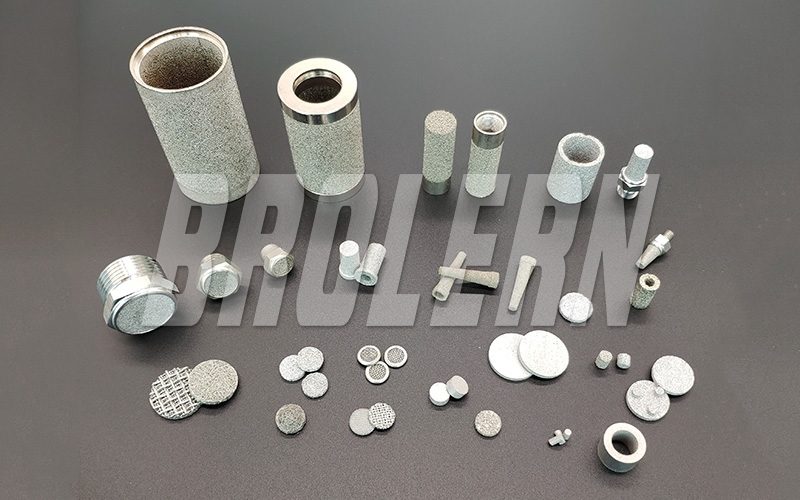
Chemical and petrochemical streams are where filter selection stops being a catalogue pick and becomes a compatibility decision. The fluid may be acidic, alkaline, solvent-based or hot; the line may run at pressure; and a wrong media choice does not just fail — it can shed, swell, embrittle or contaminate product. BROLERN supplies porous media across sintered plastic, PVF, bronze and stainless families for chemical duty. This article lays out how to choose among them for chemical and petrochemical duty.
The three questions that decide the media
- Chemical compatibility — will the media, and its seals, survive your specific fluid at your concentration and temperature?
- Temperature and pressure — polymer media have a much lower ceiling than sintered metal.
- Cleanability / reuse — do you need to clean and reuse, or is change-out acceptable?
Answer those three and the family usually picks itself.
Media options for chemical duty
| Media | Best for | Watch out for |
|---|---|---|
| PVF (fluoropolymer) | Aggressive solvents, strong acids/bases, oxidizers; high purity | Premium media — confirm exact grade vs your fluid |
| Sintered stainless (316L) | Hot, high-pressure, corrosive; cleanable and reusable | Not for fluids that attack stainless (e.g. some chlorides) |
| Sintered plastic (PE/PP) | Compatible aqueous, acids, alkalis; food-contact grades | Lower temperature/pressure ceiling than metal |
| Sintered bronze | General air/water/oil, economical porous duty | Not for aggressive chemistry or high temperature |
The full media-versus-fluid and media-versus-seal reference is in our chemical compatibility guide; the temperature and pressure limits are covered in specifying by temperature and pressure.
Why sintered metal often wins in petrochemical duty
In refining, lubrication and hydraulic-adjacent chemical service, the deciding factors are usually temperature, pressure and life-cycle cost rather than unit price. A sintered stainless steel element is rigid, self-supporting, rated from 2 to 200µm, heat-resistant and — critically — cleanable. Because contaminants can be flushed or soaked out and the element returned close to its original flow, a sintered element that costs more up front often wins on total cost of ownership across many cleaning cycles. Where the fluid is solvent-heavy rather than hot, PVF is the shedding-free, corrosion-proof alternative.
Staging a chemical filtration train
- Coarse protection — a sintered or wound stage to remove bulk solids and protect the finer, more expensive element.
- Fine polishing — a sintered or pleated absolute stage sized to the downstream component's tolerance.
- Final guard — where product purity is critical, a no-shedding PVF or sintered element as the last thing the fluid touches.
FAQ
How do I know if a media is compatible with my chemical?
Send the exact fluid, concentration and temperature. Compatibility is grade-specific — “polypropylene” or “fluoropolymer” each span a family, so we check against your chemistry rather than assume.
Can I use a plastic cartridge in a hot solvent line?
Usually not. Polymer media have a much lower temperature ceiling than sintered metal. For hot or high-pressure chemical duty, move to sintered stainless (or PVF if the chemistry attacks stainless).
What about the seals and housing?
The element is only half the wetted path. O-rings, gaskets and the housing material must be compatible too — a perfect element with the wrong seal still fails. Confirm the whole wetted set against the fluid.
Conclusion
Chemical and petrochemical filtration is a compatibility decision driven by fluid, temperature, pressure and whether you need to reuse the element. PVF handles the most aggressive chemistry, sintered stainless handles heat, pressure and reuse, and sintered plastic covers compatible aqueous duty. Send us your fluid, concentration, temperature and pressure, and the BROLERN team will recommend the media and seals — and back it with a compatibility-checked sample.